Deutsch
There are days when you sit in meetings, listening to the wildest theories, and halfway through the discussion you think:
Do they really believe this is a good idea or is it just pure marketing panic in disguise?
Twenty years in marketing leave their marks the good, the bad, and the kind you’d rather never see in a KPI dashboard.
I still remember my first campaigns in TV, radio, and print big ideas, loud messages, and expensive bills.
Today we move sliders in dashboards, push audiences around like chess pieces, and call it “performance.”
And yet the eternal question remains:
What actually works?
Here’s my honest and slightly sarcastic look back.
1. Differentiation – the holy grail that isn’t
“We need a USP!” – If I had a euro for every time I’ve heard that, I’d be writing this blog from a beach house in Crete.
The truth: Most people don’t buy because your brand is unique. They buy because they know it.
Byron Sharp proved it years ago mental availability beats “storytelling with glitter.”
Or simply put: as long as they remember you at the shelf, you’re winning.
2. Loyalty – the fairytale of eternal customers
“Focus on your existing customers!” Sure, but growth rarely happens in a roundabout.
Brands grow by recruiting new buyers, not by circling the same ones with endless remarketing.
Invest in service, not in loyalty illusions.
I like to call it the retargeting carnival loud, expensive, and not particularly productive.
3. Giveaways – for the masses
“More reach, more followers, more success!” sounds great but it’s often the marketing version of “more salt makes better food.”
People join giveaways because they want to win, not because they care about your product page.
Giveaways are fine for attention, but rarely true growth drivers.
4. Content overload – quantity kills quality
I’ve seen content plans with five blog posts per week.
Quality beats quantity and it has ever since people stopped reading Wikipedia to make purchase decisions and started asking ChatGPT or Perplexity instead.
Better one strong article with substance than ten soulless SEO clones.
5. Social media – followers aren’t currency
I once sat through a pitch where someone proudly showed 150,000 followers and zero engagement.
Followers are nice for the ego, but engagement beats vanity metrics.
Better 500 people who care than 50,000 who scroll by.
6. Email – the zombie that won’t die
Declared dead a dozen times, and still alive and kicking.
Email marketing is like vinyl: quality wins, and a well-crafted newsletter even more so.
And yes, that means: no “Hello {FIRSTNAME}” spam, but real relevance and smart automation that actually makes sense.
7. Mobile – the eternal afterthought
“We’ll optimize for mobile later.”
If I had a trigger phrase, this would be it.
More than half of all web traffic now comes from smartphones and anyone who still treats mobile UX as a side dish shouldn’t be surprised by high bounce rates.
Mobile first isn’t a trend. It’s reality.
8. Love Brands – the myth that customers love you
“Our customers love us!” No, they don’t. Sorry.
No one wakes up thinking about your brand.
People love people, not washing machines, coffee makers, or banks.
At best, your brand is pleasantly available, not emotionally irreplaceable.
9. CLV – the math of self-deception
I love numbers but sometimes we love them a little too much.
Customer Lifetime Value is a nice indicator, but it’s not a strategy.
Without constant new customer acquisition, every CLV calculation is just a nostalgic look at the past.
10. Marketing – not art, but science
Unromantic but true: marketing is measurable.
Anyone still running campaigns on gut feeling might as well roll the dice.
Data, research, repeatability that’s not a creativity killer, it’s the foundation of effectiveness.
Or as Byron Sharp puts it: “Growth isn’t a mystery. It’s math.”
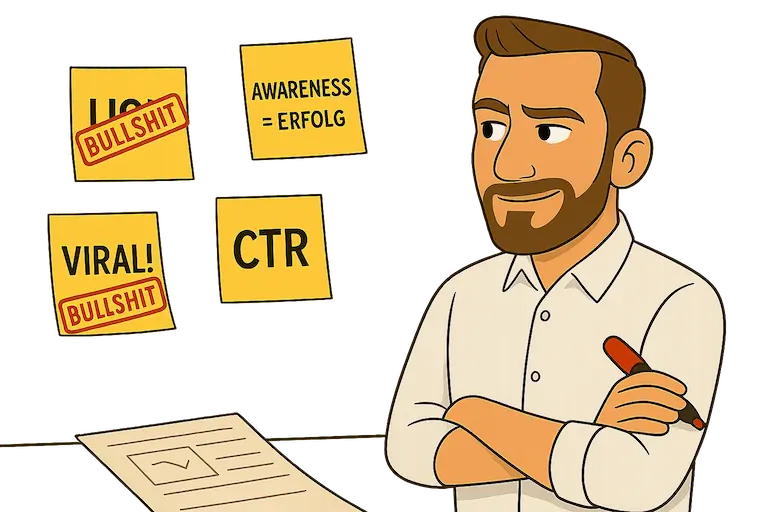
The No-Bullshit Formula
After 20 years, countless meetings, presentations, and agency debates about “purpose,” here’s what’s left:
• Maximize reach – mentally and physically
• Recruit new buyers, instead of spinning in loyalty loops
• Quality over quantity – in content, channels, and meetings 😉
• Stay flexible – read your data, challenge your beliefs
• Never stop learning
The rest?
Well… that’s the bullshit part.
No-Bullshit Marketing: Myths from 20 Years in the Game

Related Posts