Deutsch
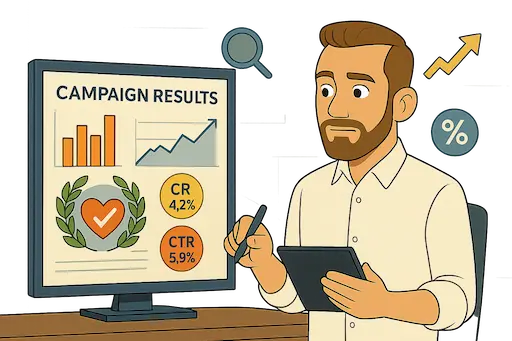
Recently, I analyzed the results of one of our recent campaigns to discuss its success with my team.
A recurring phenomenon quickly emerged: at first glance, the numbers seemed crystal clear.
One of my colleagues enthusiastically remarked, “The search campaign practically generated all of our leads! Let's shift more budget there in the future!” As some in the room eagerly agreed, thrilled about how great SEA had performed, I realized that this interpretation, although straightforward, was incomplete and not entirely correct.
So, I started with what I now call my "carousel question": “Have you considered what happened before? How and where did our customers actually interact with our campaign before they consciously searched for it?” Suddenly, the room fell silent, and I saw a few puzzled faces. This precisely highlights the problem with the last-click attribution model—it only tells half the story.
In the past, things appeared simpler as there weren't as many measurable and unmeasurable channels: a couple of impressions, a click, a conversion—done.
Today, however, reality is much more complex. Our target audiences interact with numerous touchpoints, ranging from traditional media like TV, OOH, radio, print, and social media, to email marketing, display ads, and content offerings on our own website.
The last-click model pretends that only the final click matters, completely ignoring everything that happened beforehand.
Why last-click simply isn't sufficient for performance evaluation:
Over recent years, I've often felt that the customer journey gets completely overlooked: branding and awareness campaigns, crucial for guiding customers toward conversion, are frequently disregarded. Budgets allocated to creating awareness are increasingly questioned without considering relevant market research data.
Misallocated Budgets: Those who rely solely on the last click often invest poorly—too heavily in performance marketing and too little in long-term brand building. I frequently use this example: Imagine awareness as water and your product as a sponge. Performance marketing squeezes the sponge, but if no more water (awareness) is added, the sponge eventually dries out.
Increasing Complexity: Customers now use multiple devices and channels simultaneously, making a single click hardly representative. Additionally, privacy measures increasingly obscure what users do online. While great for privacy, it certainly complicates our work.
But what alternatives do we have?
Overview of modern attribution models:
Linear: Every touchpoint receives equal credit—fair, but not always realistic.
Time-Decay: The closer to the purchase, the more significant the touchpoint—ideal for longer decision processes.
Position-based (U-shaped): First and last contacts each receive 40%, with everything in between getting 20%—excellent for complex purchase decisions.
Data-driven (Algorithmic): This model uses machine learning to individually measure the influence of each touchpoint—ideal for companies with extensive data.
However, returning to foundational principles and insights from marketing psychology can also be beneficial. Here, I frequently reference Professor Byron Sharp, who emphasizes concepts such as "Mental Availability," illustrating that brands present in the minds of customers are more likely to be purchased. A well-known example: a soft drink manufacturer continually invests in branding campaigns, not because they immediately generate sales, but because they secure long-term brand preference and recognition.
Naturally, transitioning to modern attribution comes with its own set of challenges: fragmented systems, privacy regulations, and varying attribution windows can complicate things significantly. Yet, this makes it even more important to never give up, but to continuously test, learn, and evolve.
My conclusion: The last-click model might be convenient, but it's not the entire truth. Those who aim for long-term success need to delve deeper and thoroughly understand the entire customer journey.
Why You Should Question Last-Click Models and a Suggestion for Doing it Better

Related Posts