Deutsch
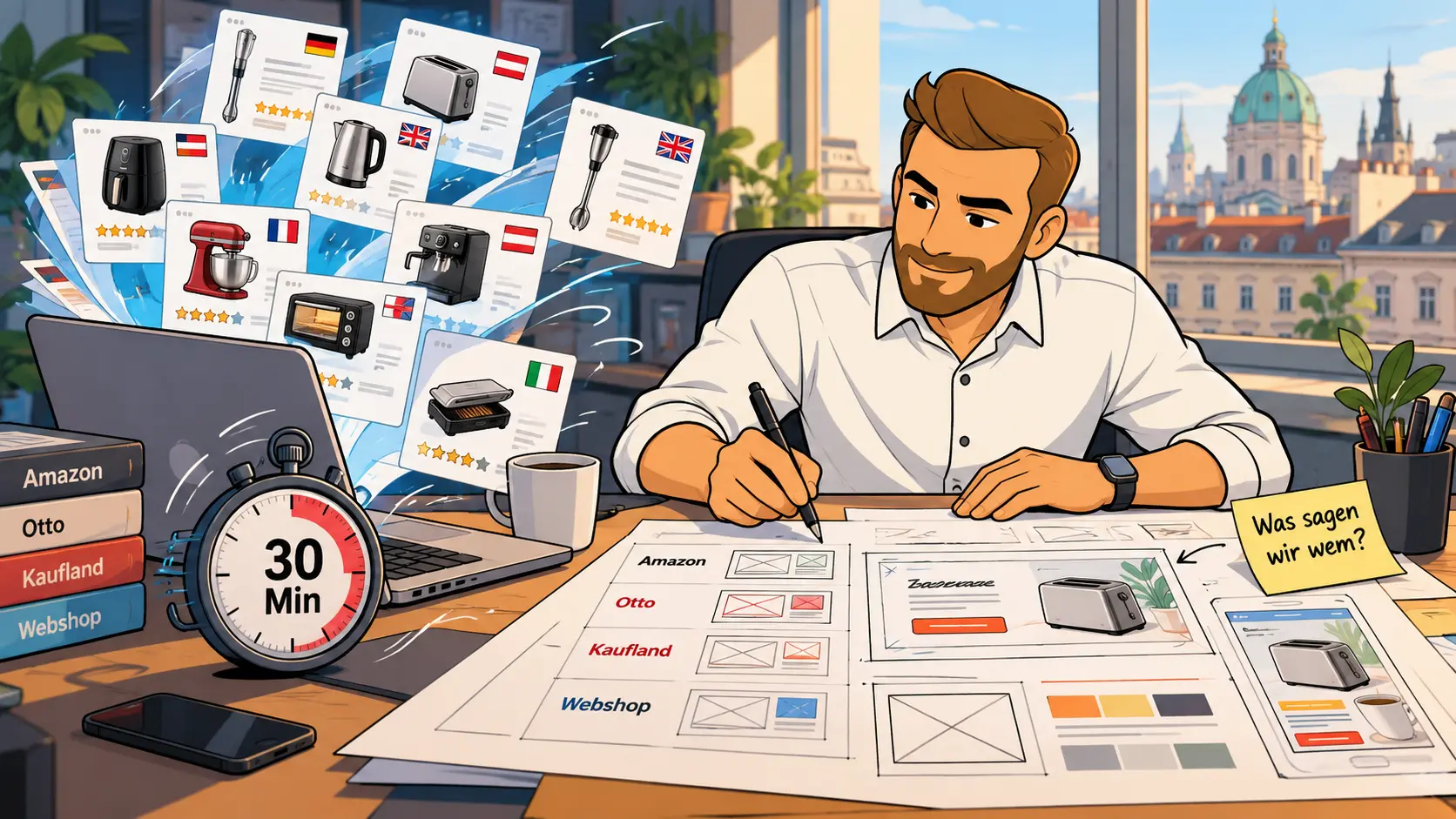
Getting product descriptions done in every language used to take hours. Now it takes less than 30 minutes. With around 400 products and markets from Austria and Germany to the UK, that is not a detail. It is the biggest change AI has brought to my team.
Still, the picture most people have of AI in marketing is wrong. In our team it made production faster. It did not make our decisions for us. And getting to good results took longer than I expected.
Fast doesn't mean good
The first AI texts were disappointing. We put in a German product description and got back a version in another language. It was grammatically correct and completely lifeless. The AI had translated it sentence by sentence, one to one.
But a product description is not a translation job. Someone in Vienna describes a hand blender differently from someone in Hamburg. German sentence structure doesn't work in the UK at all. Translate one to one and you get texts that are correct and still sound foreign. You can tell nobody from that country wrote them.
The fix was in the prompt. We learned to tell the AI exactly who it is writing for, which everyday language is normal in which market, and what it should avoid. Since then the results have been very good. But that step takes knowledge. If you don't know how customers in a market talk, you can't explain it to the AI either.
That is the most important lesson of the last few months for me. The tool is the same for everyone. The difference comes before it, from the person who knows what the result has to be.
What the team still does itself
There are areas where we deliberately don't use AI. The team designs the banners for larger campaigns. The team also handles product listings on the different platforms.
The reason for the banners is simple. A campaign is when a lot of people see our brand who rarely think about us otherwise. Colours, layout and logo have to be right. Jenni Romaniuk of the Ehrenberg-Bass Institute calls these distinctive brand assets: features that make a brand instantly recognisable. They come from years of consistency. A tool that reinterprets every request is a poor fit for that.
Listings are a different matter. Every platform has its own rules, its own fields and its own search logic. The listing is the shelf our product sits on. Stock it badly and nobody finds it, however good the copy is. That needs people who know the platform and take responsibility for the result.
Then there is the question AI can't answer at all: what do we say to whom? Which product do we put forward this autumn? Which message works in Austria? Which campaign gets the budget? Those are decisions, and the team makes them.
The real change happened in the team
What changed most was the attitude. When we started, scepticism was high. Anyone who had seen the first translations had good reason for it.
That's different now. The scepticism is gone and curiosity has grown. Our processes have changed. In product presentation especially, we try a lot of things, including variants we never would have tested before because there was no time. The results get better every month.
Better tools play a part. The bigger share comes from a team that has learned to work with them. If you know what makes a good product description, you can explain to the AI how to write one. If you don't, you get average.
As a manager, that was the more important development for me. You can buy software. You can't buy a team that's curious about it.
Faster production, the same quality of decisions
AI changed production for us. Product descriptions that used to take hours are done in under 30 minutes. What hasn't changed is what marketing is actually about: the right message for the right people, recognisable over years. That work hasn't become faster. It has become more important, because now everyone can produce quickly.
If you bring in AI and expect it to deliver the strategy too, you'll be disappointed. Give it to a team that knows what it wants, and you get more time for the decisions only people can make.