Deutsch

Yesterday I was on a panel about AI search in Vienna. Rilwan Mogaji invited us to mark five years of his agency Mogaji Digital Communications. Alongside him and me were Pedram Parsaian, founder of FOLLOW Austria, and Maximilian Mondel of MOMENTUM Wien.
Two things stuck. We all agreed that you need skilled people to use AI well. The tool alone doesn't do good work. That's why I asked the guests for one thing: keep training young people. Today's juniors are tomorrow's specialists, and those are exactly the people we need for AI to deliver good results.
The second was my point that we're seeing a renaissance of PR.
The shift is real, the panic isn't
I notice the shift in myself. A few weeks ago I was looking for a pendant light for my home, not on Google but on Perplexity. I described what I wanted, answered a few follow-up questions and got a shortlist with links. It worked well. I still didn't buy. The light was very similar, but it wasn't the one I had in mind.
I'm not the only one. According to Bitkom, half of internet users in Germany search with AI chats at least occasionally. In Austria, more than one in four people ask chatbots for product information, and among 16- to 29-year-olds it's 42 percent (CELUM/TQS, July 2026). SISTRIX calculated that Google's AI Overviews cost German websites around 265 million clicks a month. That's 6.6 percent of all organic clicks on average.
You can feel that. But it's no reason to buy the next tool.
What I consider a waste of time
Almost every week I get an offer to push our brand up in ChatGPT. Usually it's special files, texts rewritten "for AI" or dashboards that count your mentions. I haven't bought one yet.
One example is llms.txt, a file meant to tell language models what a website contains. Ahrefs analysed 137,000 domains: 97 percent of these files weren't requested a single time in May 2026. Google's own guide says you don't need new files, special markup or content chopped into chunks for its AI features. llms.txt has no effect on visibility in Google Search.
Since late August, you can buy visibility in ChatGPT officially: ChatGPT Ads now run in Germany and Austria. That's more honest than any tool promising rankings. It's advertising, and you can plan it as advertising.
What works: other people talking about you
My first point on the panel: we're seeing a renaissance of PR. The more often a brand appears across different sources, the more likely it shows up in AI answers.
This isn't a hunch. Ahrefs looked at 75,000 brands. The factor most strongly linked to being mentioned in AI Overviews is the number of brand mentions on the web (correlation 0.66). Backlinks, the currency of search engine optimisation for years, only reach 0.22. Researchers at the University of Toronto examined in September 2025 where ChatGPT, Perplexity and Gemini get their sources. In US consumer electronics, 92 percent of citations come from third-party editorial sources: reviews, media, comparison sites. On Google it's about half.
To me this is Byron Sharp in a new form. Mental availability comes from reach. Now there's also a machine between brand and customer, one that has read what's been written about you. If you don't appear in reviews, forums and media, you don't appear in the answer.
That's why we're reaching out much more to media and product testers. Germany is our big market, and our reach extends to the UK. That's where we need to show up.
Same structure on every platform
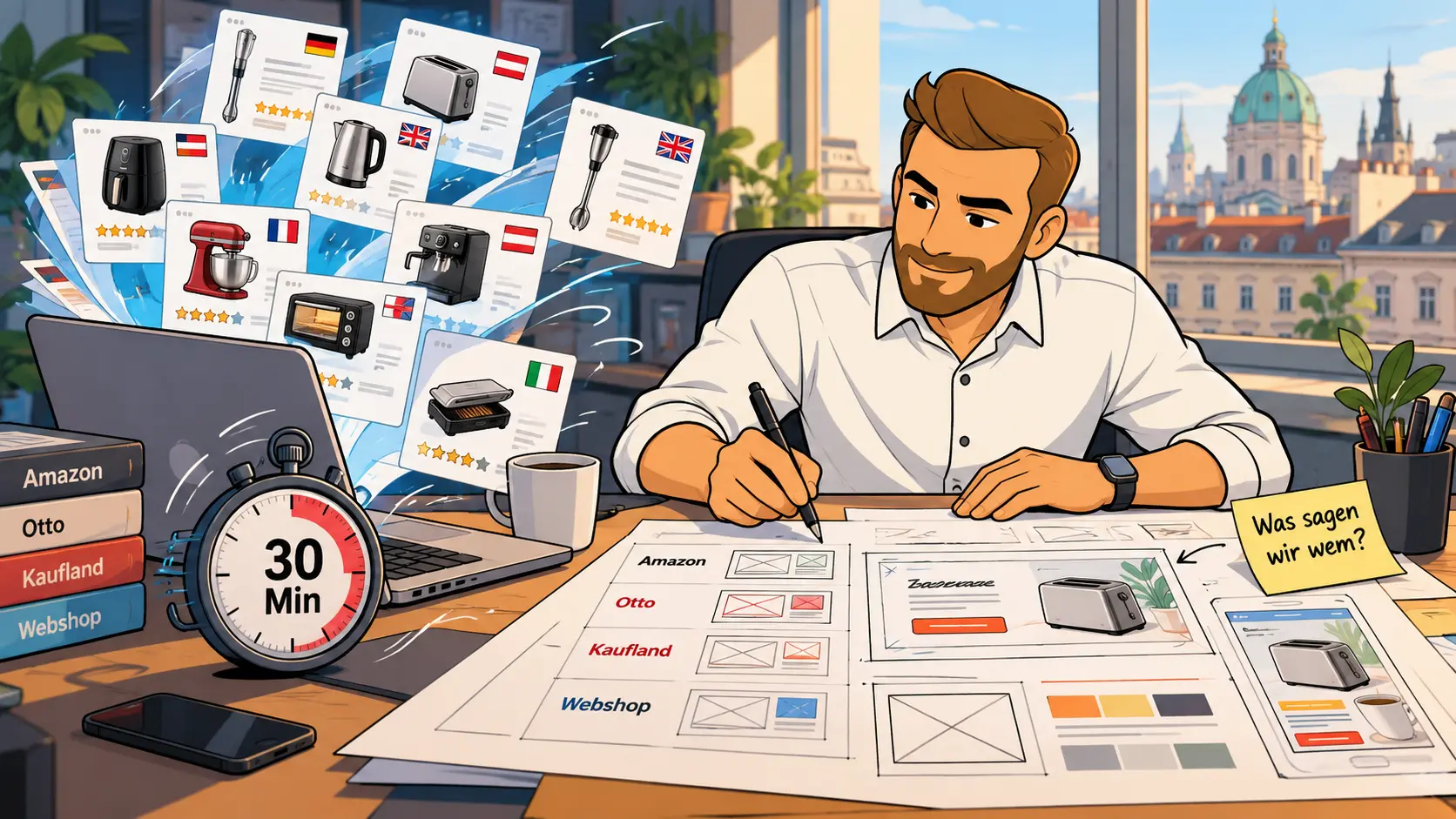
My second point: if you look the same everywhere, you get recognised more easily. So we share the same structure on every platform. Same product names, same specs, same images, same descriptions. In our own shop, on Amazon, in the feeds for Google.
People often claim that AI systems recognise consistent brands better. I haven't found a solid study that proves it. For humans it's proven: Jenni Romaniuk shows that brand assets only work if you use them consistently over a long time. I assume a machine that pieces together thousands of sources works similarly. If our blender has three different names on three platforms, it has to guess. Consistency costs little, and it definitely helps with people.
Clean data is the physical availability of this new kind of search. Google itself says up-to-date Merchant Center feeds flow into AI answers about products. Maybe my pendant light was exactly that kind of case: the right model wasn't described anywhere in a way the machine could find.
And a small business in Austria?
Not everyone has review magazines in three countries. But it works on a small scale too. Two people I know independently searched for a training course with AI. Both were recommended the same provider. The provider describes its niche so clearly and shows up in so many places that the machine can barely get around it.
For a driving school in Wels, the same logic applies. A story in the local paper, a listing with the trade association, genuine reviews, a complete Google Business Profile. Google explicitly advises local businesses to keep that profile up to date, because it feeds into AI answers to local questions. That's not a GEO strategy. It's what a good business has always done.
If you show up in media, reviews and forums today and provide clean data, you don't need a separate AI project. If you don't, you don't have an AI problem. You have a brand problem.